
The Farm Bill Explained: Where $1.37 Trillion Goes and Why Congress Is Stuck
The Morning Harvest, No. 004, Saturday, October 10, 2026 (Weekend Deep Dive)
Today in 30 seconds
The 2018 farm bill’s third one-year extension expired September 30, 2026.
Current farm bill programs are projected to cost $1.374 trillion over 10 years, and 72% is nutrition assistance.
The House passed a new bill 224 to 200. The Senate committee passed its version 12 to 11, and it needs 60 votes on the floor.
New Conservation Reserve Program contracts are paused. Crop insurance and SNAP continue.
Without action by December 31, milk supports revert to 1938 and 1949 law, near $50 per hundredweight.
The Senate bill raises direct farm ownership loan limits from $600,000 to $850,000.
What is the farm bill?
The farm bill is a multiyear law that governs most federal farm and food programs. Congress has passed one periodically since the 1930s, usually about every five years. The current bills have 12 titles: commodities, conservation, trade, nutrition, credit, rural development, research, forestry, energy, horticulture, crop insurance, and miscellaneous.
The most recent one is the Agriculture Improvement Act of 2018. It expired in 2023 and was extended three times, one year each, covering fiscal years 2024, 2025, and 2026. The last extension ended September 30, 2026.
Source: Congressional Research Service report R48918, updated July 29, 2026
How much does the farm bill cost, and where does the money go?
The Congressional Budget Office’s February 2026 baseline projects $1.374 trillion in mandatory farm bill spending for fiscal years 2027 through 2036. A baseline is the cost of continuing current programs, not the price of the new bill. CBO scored the House bill as budget neutral over 11 years.
Title10-year baselineShareNutrition (mostly SNAP)$985.4 billion71.7%Crop insurance$155.5 billion11.3%Commodities$142.6 billion10.4%Conservation$73.0 billion5.3%Horticulture (specialty crops)$2.4 billion0.18%All titles$1,373.6 billion100%
Four titles account for 99% of the total, according to CRS.
Source: CRS report R48918, Table 2
Why hasn’t Congress passed a new farm bill?
The House passed the Farm, Food, and National Security Act of 2026 (H.R. 7567) on April 30, 2026, by 224 to 200. In the Senate, Agriculture Committee Chairman John Boozman of Arkansas released the Agricultural Act of 2026 on June 23. It failed in committee 10 to 11 on August 6, then advanced 12 to 11 on September 16 on a party-line vote.
The dispute centers on SNAP. A provision of the 2025 budget reconciliation law shifts part of SNAP benefit costs to states based on payment error rates. The Senate bill delays that rule until fiscal year 2029. Committee Democrats argued for a two-year delay for all states. Boozman has said states should be more responsible with federal money and that farmers should not be “a hostage” to SNAP. Senator Cory Booker of New Jersey said the bill “fails to meet the moment of crisis facing America’s farmers and families.”
The bill needs 60 votes on the Senate floor. Congress returns November 9, and the last scheduled day of this Congress is December 18.
Sources: DTN, September 15, DTN, September 17, Farm Progress, Agri-Pulse, farmdoc Farm Policy News
What happened when the farm bill expired on September 30?
Less than the headline suggests. The 2025 reconciliation law funded crop insurance, SNAP, and most major programs through 2031. USDA told DTN the lapse “is expected to have minimal effect” at this stage.
What did stop:
Conservation Reserve Program: USDA’s Farm Service Agency has no authority to approve new contracts after September 30. The program is capped at 27 million acres.
Dairy Forward Pricing Program and Dairy Indemnity Payment Program: both paused.
Three programs with no funding: Biobased Markets, Biorefinery Assistance, and Rural Economic Development.
Sources: DTN, October 1, 2026, Ag Proud, October 5, 2026
What is the dairy cliff?
If Congress passes neither a new bill nor an extension by December 31, 2026, dairy policy reverts to “permanent law” from 1938 and 1949. That would require USDA to support milk at parity-based levels near $50 per hundredweight. A hundredweight is 100 pounds, about 11.6 gallons. For comparison, October Class III milk futures were recently near $17.
Source: Ag Proud, October 5, 2026
What does the farm bill mean for small farms and landowners?
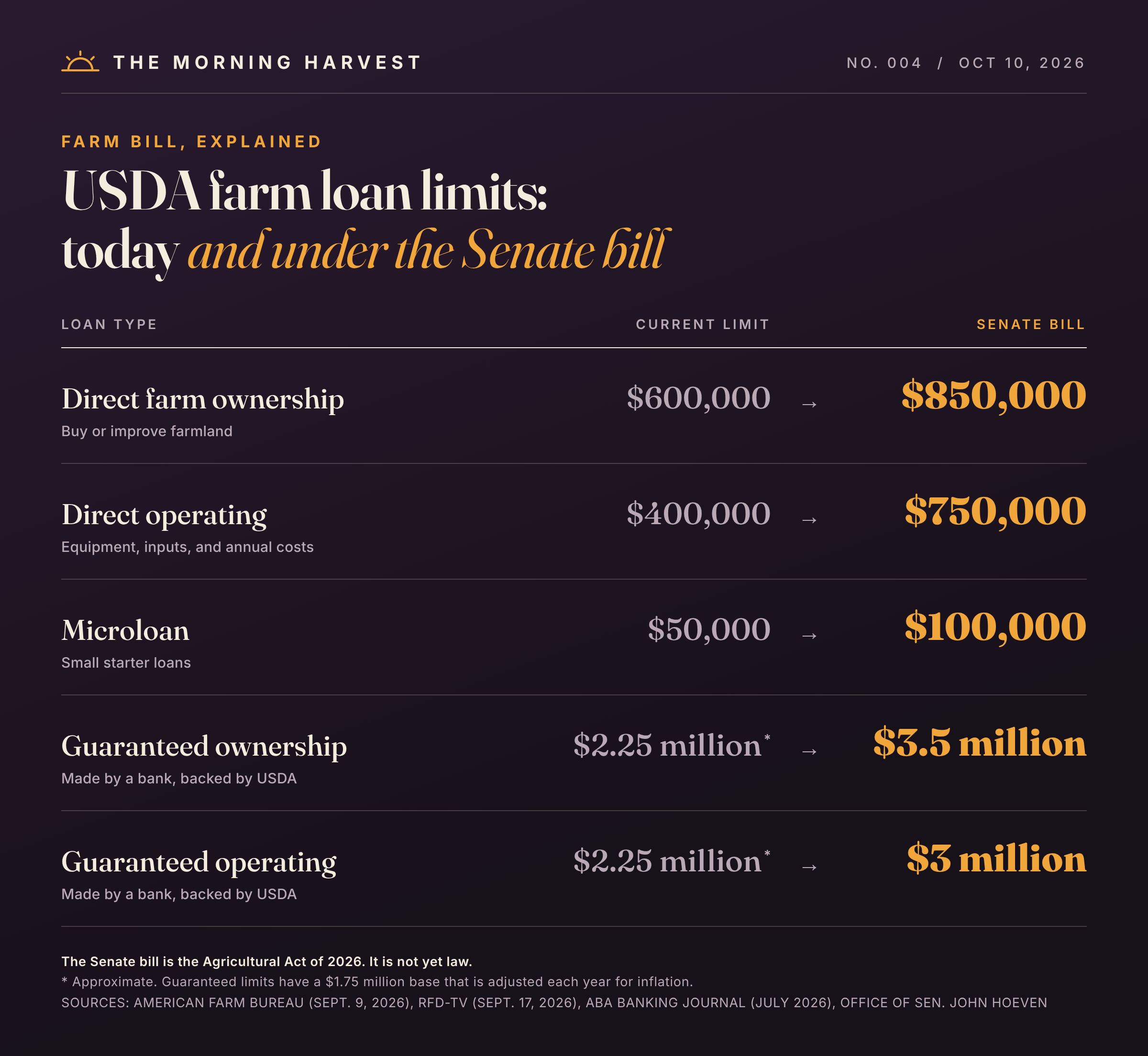
Chart comparing current USDA farm loan limits with the Senate farm bill: direct farm ownership
Pre-approval pilot: a five-year pilot would let buyers get pre-approved for direct farm ownership loans.
Tree Assistance Program: it reimburses 65% of replanting costs and 50% of rehabilitation costs for trees, bushes, and vines lost to natural disasters. Both bills allow a partial payment up front.
Specialty crops: both bills reauthorize Specialty Crop Block Grants through fiscal year 2031 and require an emergency assistance framework for specialty crop growers.
Current rates: USDA direct farm ownership loans are at 6.25% for October 2026, and down payment loans are at 2.25%.
If you own land and want to plant, you can start without waiting on Congress. See how we design and install orchards, vineyards, and berry plantings.
Sources: Talk Business and Politics, RFD-TV, September 17, 2026, ABA Banking Journal, CRS report R48918
Garden State minute: what the farm bill means for New Jersey
The New Jersey Department of Agriculture says most of the state’s agriculture falls under specialty crops: fruits, vegetables, tree nuts, horticulture, nursery crops, and floriculture. For 2026, the department received $1,023,883.78 through USDA’s Specialty Crop Block Grant Program, a farm bill program. Organizations could request up to $40,000 per project, with no match required, and applications closed May 14, 2026. The horticulture title is 0.18% of farm bill spending, and it is the part that matters most to New Jersey growers.
Sources: NJDA program page, NJDA release, April 24, 2026
From the farm: how the farm bill reaches a blackberry farm
The farm bill reaches our farm in Hammonton in two ways.
The land: the farm is financed with a USDA Farm Service Agency farm ownership loan. That is the same loan program the Senate bill would raise from $600,000 to $850,000.
The crop: our blackberries are covered by NAP, the Noninsured Crop Disaster Assistance Program, which USDA offers for crops without a regular crop insurance policy. This spring a freeze took most of our crop. NAP paid on the shortfall, and FSA gave us relief on this year’s loan payment.
On a small fruit farm, the farm bill is the loan and the safety net.
What to watch next
November 9: Congress returns for the lame-duck session.
December 11: government funding expires.
December 31: the dairy cliff.
Senate Majority Leader John Thune said this week he expects to get the farm bill “across the finish line.”
Sources: NEFI, October 6, 2026, The Hill
Stop mowing grass. Start growing fruit.
Curated Nature designs, installs, and can maintain orchards, vineyards, and berry plantings. Berries typically begin producing in their second year, grapes in their third, and tree fruit in years three to five. Start here.